8 Units vs. 9 Units: The Overlooked Regulatory Threshold for Housing in Edmonton
Published:
February 9, 2026
Housing Regulation
Housing Policy + Process
At Situate, we work on housing projects of all shapes and sizes—from small multiplexes to mid-rise and larger multi-unit buildings. Across that work, we see the same issue come up again and again.
Once a project crosses that line, additional requirements apply that affect site layout, parking, amenity space, landscaping, and building design. On small sites in particular, those requirements can materially change how a project needs to be designed—and whether it still fits on the site at all.
What makes this challenging is that the jump isn’t clearly spelled out anywhere. It’s not laid out cleanly in the Zoning Bylaw or written down in any policy. Instead, it shows up as a collection of separate regulations that all come into play at once—and hit hard.
This post explains what changes at 9 dwellings, why those changes matter, and how understanding them early can help you make better redevelopment decisions.
How housing is classified
Some of the requirements discussed below apply to any building with 9 or more dwellings, while others apply specifically to Multi-unit Housing buildings with 9 or more dwellings. That distinction is subtle, but it matters for how a building is reviewed and approved.
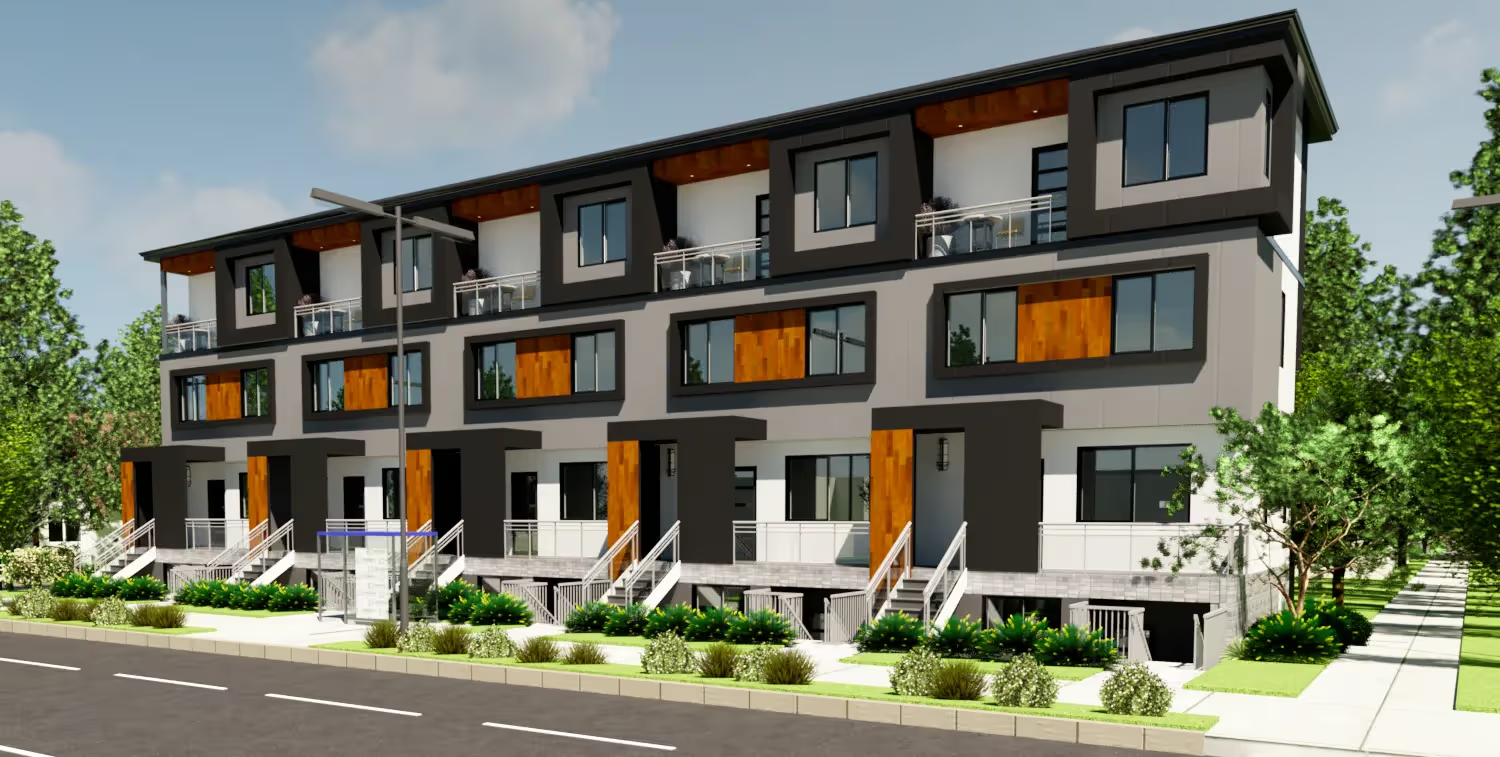
Multi-unit Housing is a specific residential use under Edmonton’s Zoning Bylaw. In practical terms, it includes buildings that do not fit within another defined residential category and that are made up entirely of principal dwellings, rather than a mix of principal dwellings and secondary suites. Common examples include stacked townhouses and apartment buildings.
What’s important here is that this classification is not based on the number of dwellings in a building. It is based on how those dwellings are arranged.
What changes once a building reaches 9 dwellings
Once a building contains 9 dwellings, a number of additional requirements apply under the Zoning Bylaw. These requirements are not grouped together or flagged as a single threshold. They come from different sections of the bylaw and apply simultaneously.
These rules apply city-wide and across zones. They are not triggered by zoning designation. That said, they are often most constraining on smaller residential sites, simply because those sites have less room to accommodate additional requirements. Although many of those sites are zoned RSM or RM, 9 or more dwellings of Multi-unit Housing is also possible on some larger RS corner sites.
Amenity area requirements
Buildings with 9 or more dwellings are required to provide a minimum amenity area of 7.5 square metres per dwelling. This can include private balconies, rooftop gardens, or common indoor spaces like gyms or lounges.
This requirement applies regardless of whether the dwellings are arranged as Row Housing, principal dwellings (such as row houses) with Secondary Suites, or Multi-unit Housing. On smaller sites, amenity area quickly competes with parking, landscaping, and the building footprint, and it can become a binding constraint as unit counts increase.
A quick note on parking
Edmonton does not have minimum vehicle parking requirements for most residential buildings. That often leads people to assume that parking is largely optional from a regulatory perspective.
That isn’t quite true.
While there are no minimum vehicle parking counts, the Zoning Bylaw does impose requirements for barrier-free parking, and bike parking in specific circumstances. These requirements are mandatory when they apply, and they can have a significant impact on site layout.
Barrier-free parking
Barrier-free parking is required for Multi-unit Housing buildings with 9 or more dwellings.
It is not required for Row Housing or buildings made up of principal dwellings with Secondary Suites.
For Multi-unit Housing buildings with 9 to 20 dwellings, two barrier-free parking stalls are required. These stalls are larger and have specific access and circulation requirements. On smaller sites, accommodating them has an outsized impact on site layout.
Bike parking
Bike parking is also required for Multi-unit Housing buildings with 9 or more dwellings.
It is not required for Row Housing or for buildings made up of principal dwellings with Secondary Suites.
The bike parking requirements distinguish between long-term and short-term bike parking, horizontal and vertical stalls, and inclusive bike parking stalls that must meet additional size and accessibility standards. The way these requirements interact is not intuitive, and the space required for compliant bike parking is frequently underestimated.
Long-term bike parking as an accessory building
Long-term bike parking must be enclosed, so it may trigger accessory building requirements under the Zoning Bylaw.
Accessory buildings count toward site coverage and reduce the amount of space available for soft landscaping. On small sites, introducing an accessory building for bike parking often forces trade-offs elsewhere on the site.
There are also practical design considerations. Many off-the-shelf bike lockers do not meet the Zoning Bylaw’s minimum depth, length, or vertical clearance requirements. Securing them properly—often to a concrete pad—can further constrain site design. Where minimum dimensions are not met, a variance is required.
Soft landscaping requirements
In the RS and RSM zones, soft landscaping requirements apply regardless of unit count, but they become harder to meet as additional elements are introduced on site.
In the RS Zone, a minimum of 30 percent of the site must be soft landscaped.
In the RSM Zone, the minimum is 25 percent.
These requirements apply for Row Housing, buildings made up of principal dwellings with Secondary Suites, and Multi-unit Housing. As amenity areas, accessory buildings, barrier-free parking stalls, and fully hard-surfaced parking areas are added, it becomes increasingly difficult to provide the required amount of soft landscaping.
Hard-surfacing rules for parking areas
The hard-surfacing rules for parking areas are, frankly, unusual. Once a Multi-unit Housing building contains 9 or more dwellings, surface parking areas must be entirely hard-surfaced, which directly reduces the amount of space available to count toward soft landscaping.
For Multi-Unit Housing with 8 dwellings or fewer, Row Housing, or buildings made up of principal dwellings with Secondary Suites, the bylaw allows a more flexible approach. Parking areas may be designed with hard-surfaced tire tracks and soft landscaping between them, making it easier to meet the soft landscaping requirement.
This distinction has a real impact on site design. On sites where space is already tight, the shift to fully hard-surfaced parking can materially affect whether a layout still works.
Waste management: carts versus bins
There is no explicit unit-count trigger for waste management. However, as the number of dwellings increases, waste bins are often required instead of carts.
Bins take up more space, require access, and need to be accommodated alongside parking, landscaping, and amenity areas. Like bike parking, waste management frequently becomes a constraint late in the design process.
Secondary suites and design intent
Requirements for Multi-unit Housing with 9 or more dwellings can be avoided by incorporating Secondary Suites instead of only principal dwellings. Whether a dwelling is treated as a Secondary Suite is determined by design, not by how it is labelled.
From a zoning bylaw perspective, a Secondary Suite must share a mechanical room with its associated principal dwelling, and a shared common indoor landing is strongly encouraged. Where the Secondary Suite is only slightly smaller than the principal dwelling, a written justification is required to demonstrate that the suite is subordinate.
So, should you do 8 dwellings or 9?
There is no universal answer.
What matters is understanding that adding a ninth dwelling is not a marginal change from an approvals perspective. It brings a different set of requirements into play, and those requirements interact with each other in complex and often unexpected ways.
In some cases, fewer dwellings result in a simpler, faster, and lower-risk approval. In others, the additional requirements are worth taking on.
If you are figuring out a site design or weighing whether 8 dwellings or 9 dwellings makes sense for a site, this is exactly the type of conversation we help with. Scheduling that discussion early can prevent redesigns, delays, and surprises later in the process.
If you’d like to talk it through, schedule a chat with Situate.
Let’s Talk About Your Project
Curious how this could apply to your situation? Let’s have a quick conversation and explore what’s possible.
If You’re Building More Housing, You Deserve a Smooth Approval
Our cities need more housing, and we don’t think anything should stand in the way. Book a call and let’s map the fastest path to yes.